Tuesday, January 03, 2012
THE UNITED STATES CONSTITUTION
(See Note 1)
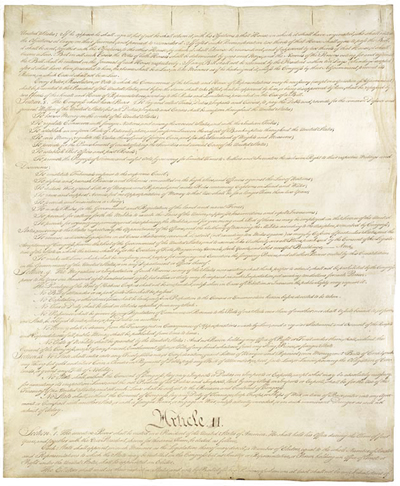
We the People of the United States, in Order to form a more
perfect Union, establish Justice, insure domestic Tranquility,
provide for the common defence, promote the general Welfare,
and secure the Blessings of Liberty to ourselves and our Posterity,
do ordain and establish this Constitution for the United States
of America.
Article. I.
Section 1.
All legislative Powers herein granted shall
be vested in a Congress of the United States, which shall consist of
a Senate and House of Representatives.
Section. 2.
Clause 1: The House of Representatives shall be composed
of Members chosen every second Year by the People of the several
States, and the Electors in each State shall have the
Qualifications requisite for Electors of the most numerous Branch
of the State Legislature.
Clause 2: No Person shall be a Representative who shall not have
attained to the Age of twenty five Years, and been seven Years a
Citizen of the United States, and who shall not, when elected, be
an Inhabitant of that State in which he shall be chosen.
Clause 3: Representatives and direct Taxes shall be apportioned
among the several States which may be included within this Union,
according to their respective Numbers, which shall be determined
by adding to the whole Number of free Persons, including those
bound to Service for a Term of Years, and excluding Indians not
taxed, three fifths of all other Persons. (See Note 2) The
actual Enumeration shall be made within three Years after the first
Meeting of the Congress of the United States, and within every
subsequent Term of ten Years, in such Manner as they shall by Law
direct. The Number of Representatives shall not exceed one for
every thirty Thousand, but each State shall have at Least one
Representative; and until such enumeration shall be made, the
State of New Hampshire shall be entitled to chuse three,
Massachusetts eight, Rhode-Island and Providence Plantations one,
Connecticut five, New-York six, New Jersey four, Pennsylvania
eight, Delaware one, Maryland six, Virginia ten, North Carolina
five, South Carolina five, and Georgia three.
Clause 4: When vacancies happen in the Representation from any
State, the Executive Authority thereof shall issue Writs of Election
to fill such Vacancies.
Clause 5: The House of Representatives shall chuse their Speaker and
other Officers; and shall have the sole Power of Impeachment.
Section. 3.
Clause 1: The Senate of the United States shall be composed of
two Senators from each State, chosen by the Legislature thereof,
(See Note 3) for six Years; and each Senator shall
have one Vote.
Clause 2: Immediately after they shall be assembled in Consequence
of the first Election, they shall be divided as equally as may be
into three Classes. The Seats of the Senators of the first Class
shall be vacated at the Expiration of the second Year, of the
second Class at the Expiration of the fourth Year, and of the
third Class at the Expiration of the sixth Year, so that one
third may be chosen every second Year; and if Vacancies happen by
Resignation, or otherwise, during the Recess of the Legislature
of any State, the Executive thereof may make temporary
Appointments until the next Meeting of the Legislature, which
shall then fill such Vacancies. (See Note 4)
Clause 3: No Person shall be a Senator who shall not have
attained to the Age of thirty Years, and been nine Years a Citizen
of the United States, and who shall not, when elected, be an
Inhabitant of that State for which he shall be chosen.
Clause 4: The Vice President of the United States shall be President
of the Senate, but shall have no Vote, unless they be equally
divided.
Clause 5: The Senate shall chuse their other Officers, and also a
President pro tempore, in the Absence of the Vice President, or
when he shall exercise the Office of President of the United States.
Clause 6: The Senate shall have the sole Power to try all
Impeachments. When sitting for that Purpose, they shall be on
Oath or Affirmation. When the President of the United States is
tried, the Chief Justice shall preside: And no Person shall be
convicted without the Concurrence of two thirds of the Members
present.
Clause 7: Judgment in Cases of Impeachment shall not extend further
than to removal from Office, and disqualification to hold and
enjoy any Office of honor, Trust or Profit under the United
States: but the Party convicted shall nevertheless be liable and
subject to Indictment, Trial, Judgment and Punishment, according
to Law.
Section. 4.
Clause 1: The Times, Places and Manner of holding
Elections for Senators and Representatives, shall be prescribed
in each State by the Legislature thereof; but the Congress may at
any time by Law make or alter such Regulations, except as to the
Places of chusing Senators.
Clause 2: The Congress shall assemble at least once in every Year,
and such Meeting shall be on the first Monday in December, (See Note
5) unless they shall by Law appoint a different Day.
Section. 5.
Clause 1: Each House shall be the Judge of the Elections,
Returns and Qualifications of its own Members, and a Majority of
each shall constitute a Quorum to do Business; but a smaller
Number may adjourn from day to day, and may be authorized to
compel the Attendance of absent Members, in such Manner, and
under such Penalties as each House may provide.
Clause 2: Each House may determine the Rules of its Proceedings,
punish its Members for disorderly Behaviour, and, with the
Concurrence of two thirds, expel a Member.
Clause 3: Each House shall keep a Journal of its Proceedings, and
from time to time publish the same, excepting such Parts as may
in their Judgment require Secrecy; and the Yeas and Nays of the
Members of either House on any question shall, at the Desire of
one fifth of those Present, be entered on the Journal.
Clause 4: Neither House, during the Session of Congress, shall,
without the Consent of the other, adjourn for more than three
days, nor to any other Place than that in which the two Houses
shall be sitting.
Section. 6.
Clause 1: The Senators and Representatives shall receive
a Compensation for their Services, to be ascertained by Law, and
paid out of the Treasury of the United States. (See Note 6)
They shall in all Cases, except Treason, Felony and Breach of the
Peace, beprivileged from Arrest during their Attendance at the
Session of their respective Houses, and in going to and returning
from the same; and for any Speech or Debate in either House,
they shall not be questioned in any other Place.
Clause 2: No Senator or Representative shall, during the Time for
which he was elected, be appointed to any civil Office under the
Authority of the United States, which shall have been created, or
the Emoluments whereof shall have been encreased during such
time; and no Person holding any Office under the United States,
shall be a Member of either House during his Continuance in
Office.
Section. 7.
Clause 1: All Bills for raising Revenue shall originate
in the House of Representatives; but the Senate may propose or
concur with Amendments as on other Bills.
Clause 2: Every Bill which shall have passed the House of
Representatives and the Senate, shall, before it become a Law, be
presented to the President of the United States; If he approve he
shall sign it, but if not he shall return it, with his Objections
to that House in which it shall have originated, who shall enter
the Objections at large on their Journal, and proceed to
reconsider it. If after such Reconsideration two thirds of that
House shall agree to pass the Bill, it shall be sent, together
with the Objections, to the other House, by which it shall
likewise be reconsidered, and if approved by two thirds of that
House, it shall become a Law. But in all such Cases the Votes of
both Houses shall be determined by yeas and Nays, and the Names
of the Persons voting for and against the Bill shall be entered
on the Journal of each House respectively. If any Bill shall not
be returned by the President within ten Days (Sundays excepted)
after it shall have been presented to him, the Same shall be a
Law, in like Manner as if he had signed it, unless the Congress
by their Adjournment prevent its Return, in which Case it shall
not be a Law.
Clause 3: Every Order, Resolution, or Vote to which the Concurrence
of the Senate and House of Representatives may be necessary
(except on a question of Adjournment) shall be presented to the
President of the United States; and before the Same shall take
Effect, shall be approved by him, or being disapproved by him,
shall be repassed by two thirds of the Senate and House of
Representatives, according to the Rules and Limitations
prescribed in the Case of a Bill.
Section. 8.
Clause 1: The Congress shall have Power To lay and
collect Taxes, Duties, Imposts and Excises, to pay the Debts and
provide for the common Defence and general Welfare of the United
States; but all Duties, Imposts and Excises shall be uniform
throughout the United States;
Clause 2: To borrow Money on the credit of the United States;
Clause 3: To regulate Commerce with foreign Nations, and among the
several States, and with the Indian Tribes;
Clause 4: To establish an uniform Rule of Naturalization, and
uniform Laws on the subject of Bankruptcies throughout the United
States;
Clause 5: To coin Money, regulate the Value thereof, and of foreign
Coin, and fix the Standard of Weights and Measures;
Clause 6: To provide for the Punishment of counterfeiting the
Securities and current Coin of the United States;
Clause 7: To establish Post Offices and post Roads;
Clause 8: To promote the Progress of Science and useful Arts, by
securing for limited Times to Authors and Inventors the exclusive
Right to their respective Writings and Discoveries;
Clause 9: To constitute Tribunals inferior to the supreme Court;
Clause 10: To define and punish Piracies and Felonies committed on
the high Seas, and Offences against the Law of Nations;
Clause 11: To declare War, grant Letters of Marque and Reprisal, and
make Rules concerning Captures on Land and Water;
Clause 12: To raise and support Armies, but no Appropriation of
Money to that Use shall be for a longer Term than two Years;
Clause 13: To provide and maintain a Navy;
Clause 14: To make Rules for the Government and Regulation of the
land and naval Forces;
Clause 15: To provide for calling forth the Militia to execute the
Laws of the Union, suppress Insurrections and repel Invasions;
Clause 16: To provide for organizing, arming, and disciplining, the
Militia, and for governing such Part of them as may be employed
in the Service of the United States, reserving to the States
respectively, the Appointment of the Officers, and the Authority
of training the Militia according to the discipline prescribed by
Congress;
Clause 17: To exercise exclusive Legislation in all Cases
whatsoever, over such District (not exceeding ten Miles square)
as may, byCession of particular States, and the Acceptance of Congress,
become the Seat of the Government of the United States, and to
exercise like Authority over all Places purchased by the Consent
of the Legislature of the State in which the Same shall be, for
the Erection of Forts, Magazines, Arsenals, dock-Yards, and other
needful Buildings;--And
Clause 18: To make all Laws which shall be necessary and proper for
carrying into Execution the foregoing Powers, and all other
Powers vested by this Constitution in the Government of the
United States, or in any Department or Officer thereof.
Section. 9.
Clause 1: The Migration or Importation of such Persons as
any of the States now existing shall think proper to admit, shall
not be prohibited by the Congress prior to the Year one thousand
eight hundred and eight, but a Tax or duty may be imposed on such
Importation, not exceeding ten dollars for each Person.
Clause 2: The Privilege of the Writ of Habeas Corpus shall not be
suspended, unless when in Cases of Rebellion or Invasion the
public Safety may require it.
Clause 3: No Bill of Attainder or ex post facto Law shall be passed.
Clause 4: No Capitation, or other direct, Tax shall be laid, unless
in Proportion to the Census or Enumeration herein before directed
to be taken. (See Note 7)
Clause 5: No Tax or Duty shall be laid on Articles exported from any
State.
Clause 6: No Preference shall be given by any Regulation of Commerce
or Revenue to the Ports of one State over those of another: nor
shall Vessels bound to, or from, one State, be obliged to enter,
clear, or pay Duties in another.
Clause 7: No Money shall be drawn from the Treasury, but in
Consequence of Appropriations made by Law; and a regular
Statement and Account of the Receipts and Expenditures of all
public Money shall be published from time to time.
Clause 8: No Title of Nobility shall be granted by the United
States: And no Person holding any Office of Profit or Trust under them,
shall, without the Consent of the Congress, accept of any
present, Emolument, Office, or Title, of any kind whatever, from
any King, Prince, or foreign State.
Section. 10.
Clause 1: No State shall enter into any Treaty,
Alliance, or Confederation; grant Letters of Marque and Reprisal;
coin Money; emit Bills of Credit; make any Thing but gold and
silver Coin a Tender in Payment of Debts; pass any Bill of
Attainder, ex post facto Law, or Law impairing the Obligation of
Contracts, or grant any Title of Nobility.
Clause 2: No State shall, without the Consent of the Congress, lay
any Imposts or Duties on Imports or Exports, except what may be
absolutely necessary for executing it's inspection Laws: and the
net Produce of all Duties and Imposts, laid by any State on
Imports or Exports, shall be for the Use of the Treasury of the
United States; and all such Laws shall be subject to the Revision
and Controul of the Congress.
Clause 3: No State shall, without the Consent of Congress, lay any
Duty of Tonnage, keep Troops, or Ships of War in time of Peace,
enter into any Agreement or Compact with another State, or with a
foreign Power, or engage in War, unless actually invaded, or in
such imminent Danger as will not admit of delay.
Article. II.
Section. 1.
Clause 1: The executive Power shall be vested in a
President of the United States of America. He shall hold his
Office during the Term of four Years, and, together with the Vice
President, chosen for the same Term, be elected, as follows
Clause 2: Each State shall appoint, in such Manner as the
Legislature thereof may direct, a Number of Electors, equal to the
whole Number of Senators and Representatives to which the State may
be entitled in the Congress: but no Senator or Representative, or
Person holding an Office of Trust or Profit under the United
States, shall be appointed an Elector.
Clause 3: The Electors shall meet in their respective States, and
vote by Ballot for two Persons, of whom one at least shall not be
an Inhabitant of the same State with themselves. And they shall
make a List of all the Persons voted for, and of the Number of
Votes for each; which List they shall sign and certify, and
transmit sealed to the Seat of the Government of the United
States, directed to the President of the Senate. The President of
the Senate shall, in the Presence of the Senate and House of
Representatives, open all the Certificates, and the Votes shall
then be counted. The Person having the greatest Number of Votes
shall be the President, if such Number be a Majority of the whole
Number of Electors appointed; and if there be more than one who
have such Majority, and have an equal Number of Votes, then the
House of Representatives shall immediately chuse by Ballot one of
them for President; and if no Person have a Majority, then from
the five highest on the List the said House shall in like Manner
chuse the President. But in chusing the President, the Votes
shall be taken by States, the Representation from each State
having one Vote; A quorum for this Purpose shall consist of a
Member or Members from two thirds of the States, and a Majority
of all the States shall be necessary to a Choice. In every Case,
after the Choice of the President, the Person having the greatest
Number of Votes of the Electors shall be the Vice President. But
if there should remain two or more who have equal Votes, the
Senate shall chuse from them by Ballot the Vice President. (See Note
8)
Clause 4: The Congress may determine the Time of chusing the
Electors, and the Day on which they shall give their Votes; which
Day shall be the same throughout the United States.
Clause 5: No Person except a natural born Citizen, or a Citizen of
the United States, at the time of the Adoption of this
Constitution, shall be eligible to the Office of President;
neither shall any Person be eligible to that Office who shall not
have attained to the Age of thirty five Years, and been fourteen
Years a Resident within the United States.
Clause 6: In Case of the Removal of the President from Office,
or of his Death, Resignation, or Inability to discharge the Powers
and Duties of the said Office, (See Note 9) the Same shall
devolve on the VicePresident, and the Congress may by Law provide for
the Case of Removal, Death, Resignation or Inability, both of the
President and Vice President, declaring what Officer shall then
act as President, and such Officer shall act accordingly, until
the Disability be removed, or a President shall be elected.
Clause 7: The President shall, at stated Times, receive for his
Services, a Compensation, which shall neither be encreased nor
diminished during the Period for which he shall have been
elected, and he shall not receive within that Period any other
Emolument from the United States, or any of them.
Clause 8: Before he enter on the Execution of his Office, he shall
take the following Oath or Affirmation:--"I do solemnly swear
(or affirm) that I will faithfully execute the Office of
President of the United States, and will to the best of my
Ability, preserve, protect and defend the Constitution of the
United States."
Section. 2.
Clause 1: The President shall be Commander in Chief of
the Army and Navy of the United States, and of the Militia of the
several States, when called into the actual Service of the United
States; he may require the Opinion, in writing, of the principal
Officer in each of the executive Departments, upon any Subject
relating to the Duties of their respective Offices, and he shall
have Power to grant Reprieves and Pardons for Offences against
the United States, except in Cases of Impeachment.
Clause 2: He shall have Power, by and with the Advice and Consent of
the Senate, to make Treaties, provided two thirds of the Senators
present concur; and he shall nominate, and by and with the Advice
and Consent of the Senate, shall appoint Ambassadors, other
public Ministers and Consuls, Judges of the supreme Court, and
all other Officers of the United States, whose Appointments are
not herein otherwise provided for, and which shall be established
by Law: but the Congress may by Law vest the Appointment of such
inferior Officers, as they think proper, in the President alone,
in the Courts of Law, or in the Heads of Departments.
Clause 3: The President shall have Power to fill up all Vacancies
that may happen during the Recess of the Senate, by granting
Commissions which shall expire at the End of their next Session.
Section. 3.
He shall from time to time give to the Congress
Information of the State of the Union, and recommend to their
Consideration such Measures as he shall judge necessary and
expedient; he may, on extraordinary Occasions, convene both
Houses, or either of them, and in Case of Disagreement between
them, with Respect to the Time of Adjournment, he may adjourn
them to such Time as he shall think proper; he shall receive
Ambassadors and other public Ministers; he shall take Care that
the Laws be faithfully executed, and shall Commission all the
Officers of the United States.
Section. 4.
The President, Vice President and all civil
Officers of the United States, shall be removed from Office on
Impeachment for, and Conviction of, Treason, Bribery, or other high
Crimes and Misdemeanors.
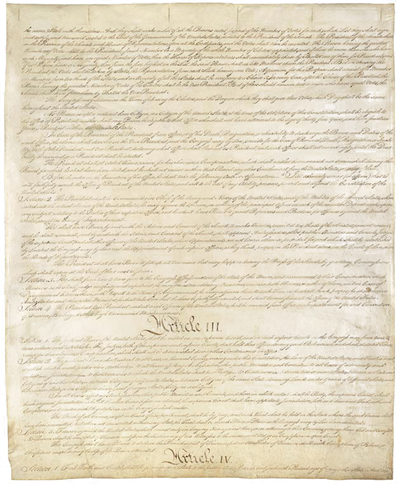
Article. III.
Section. 1.
The judicial Power of the United States, shall
be vested in one supreme Court, and in such inferior Courts as the
Congress may from time to time ordain and establish. The Judges,
both of the supreme and inferior Courts, shall hold their Offices
during good Behaviour, and shall, at stated Times, receive for
their Services, a Compensation, which shall not be diminished
during their Continuance in Office.
Section. 2.
Clause 1: The judicial Power shall extend to all Cases,
in Law and Equity, arising under this Constitution, the Laws of
the United States, and Treaties made, or which shall be made,
under their Authority;--to all Cases affecting Ambassadors, other
public Ministers and Consuls;--to all Cases of admiralty and
maritime Jurisdiction;--to Controversies to which the United
States shall be a Party;--to Controversies between two or more
States;--between a State and Citizens of another State;
(See Note 10)--between Citizens of different States,
--between Citizens of the same State claiming Lands under Grants
of different States, and between a State, or the Citizens thereof,
and foreign States, Citizens or Subjects.
Clause 2: In all Cases affecting Ambassadors, other public Ministers
and Consuls, and those in which a State shall be Party, the
supreme Court shall have original Jurisdiction. In all the other
Cases before mentioned, the supreme Court shall have appellate
Jurisdiction, both as to Law and Fact, with such Exceptions, and
under such Regulations as the Congress shall make.
Clause 3: The Trial of all Crimes, except in Cases of Impeachment,
shall be by Jury; and such Trial shall be held in the State where
the said Crimes shall have been committed; but when not committed
within any State, the Trial shall be at such Place or Places as
the Congress may by Law have directed.
Section. 3.
Clause 1: Treason against the United States, shall
consist only in levying War against them, or in adhering to their
Enemies, giving them Aid and Comfort. No Person shall be
convicted of Treason unless on the Testimony of two Witnesses to
the same overt Act, or on Confession in open Court.
Clause 2: The Congress shall have Power to declare the Punishment of
Treason, but no Attainder of Treason shall work Corruption of
Blood, or Forfeiture except during the Life of the Person
attainted.
Article. IV.
Section. 1.
Full Faith and Credit shall be given in each
State to the public Acts, Records, and judicial Proceedings of every
other State. And the Congress may by general Laws prescribe the Manner
in which such Acts, Records and Proceedings shall be proved, and
the Effect thereof.
Section. 2.
Clause 1: The Citizens of each State shall be entitled to
all Privileges and Immunities of Citizens in the several States.
Clause 2: A Person charged in any State with Treason, Felony, or
other Crime, who shall flee from Justice, and be found in another
State, shall on Demand of the executive Authority of the State
from which he fled, be delivered up, to be removed to the State
having Jurisdiction of the Crime.
Clause 3: No Person held to Service or Labour in one State, under
the Laws thereof, escaping into another, shall, in Consequence of any
Law or Regulation therein, be discharged from such Service or
Labour, but shall be delivered up on Claim of the Party to whom
such Service or Labour may be due. (See Note 11)
Section. 3.
Clause 1: New States may be admitted by the Congress into
this Union; but no new State shall be formed or erected within
the Jurisdiction of any other State; nor any State be formed by
the Junction of two or more States, or Parts of States, without
the Consent of the Legislatures of the States concerned as well
as of the Congress.
Clause 2: The Congress shall have Power to dispose of and make all
needful Rules and Regulations respecting the Territory or other
Property belonging to the United States; and nothing in this
Constitution shall be so construed as to Prejudice any Claims of
the United States, or of any particular State.
Section. 4.
The United States shall guarantee to every
State in this Union a Republican Form of Government, and shall protect
each of them against Invasion; and on Application of the
Legislature, or of the Executive (when the Legislature cannot be
convened) against domestic Violence.
Article. V.
The Congress, whenever two thirds of both Houses shall deem it
necessary, shall propose Amendments to this
Constitution, or, on
the Application of the Legislatures of two thirds of the several
States, shall call a Convention for proposing Amendments, which,
in either Case, shall be valid to all Intents and Purposes, as
Part of this Constitution, when ratified by the Legislatures of
three fourths of the several States, or by Conventions in three
fourths thereof, as the one or the other Mode of Ratification may
be proposed by the Congress; Provided that no Amendment which may
be made prior to the Year One thousand eight hundred and eight
shall in any Manner affect the first and fourth Clauses in the
Ninth Section of the first Article; and that no State, without
its Consent, shall be deprived of its equal Suffrage in the
Senate.
Article. VI.
Clause 1: All Debts contracted and Engagements entered into, before
the Adoption of this Constitution, shall be as valid against the
United States under this Constitution, as under the Confederation.
Clause 2: This Constitution, and the Laws of the United States which
shall be made in Pursuance thereof; and all Treaties made, or
which shall be made, under the Authority of the United States,
shall be the supreme Law of the Land; and the Judges in every
State shall be bound thereby, any Thing in the Constitution or
Laws of any State to the Contrary notwithstanding.
Clause 3: The Senators and Representatives before mentioned, and the
Members of the several State Legislatures, and all executive and
judicial Officers, both of the United States and of the several
States, shall be bound by Oath or Affirmation, to support this
Constitution; but no religious Test shall ever be required as a
Qualification to any Office or public Trust under the United
States.
Article. VII.
The Ratification of the Conventions of nine States, shall be
sufficient for the Establishment of this Constitution between the
States so ratifying the Same.
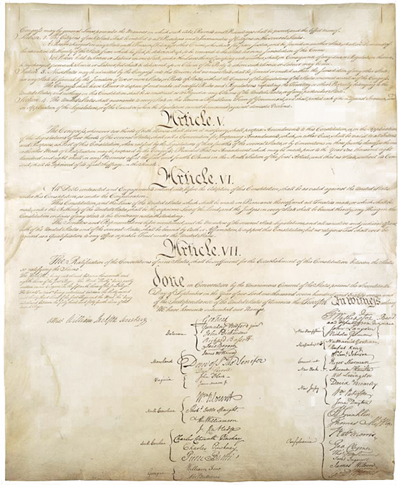
done in Convention by the Unanimous Consent of the States present
the Seventeenth Day of September in the Year of our Lord one
thousand seven hundred and Eighty seven and of the Independence
of the United States of America the Twelfth In witness whereof
We have hereunto subscribed our Names,
GO WASHINGTON--Presidt.
and deputy from Virginia
[Signed also by the deputies of twelve States.]
Delaware
Geo: Read
Gunning Bedford jun
John Dickinson
Richard Bassett
Jaco: Broom
Maryland
James MCHenry
Dan of ST ThoS. Jenifer
DanL Carroll.
Virginia
John Blair--
James Madison Jr.
North Carolina
WM Blount
RichD. Dobbs Spaight.
Hu Williamson
South Carolina
J. Rutledge
Charles 1ACotesworth Pinckney
Charles Pinckney
Pierce Butler.
Georgia
William Few
Abr Baldwin
New Hampshire
John Langdon
Nicholas Gilman
Massachusetts
Nathaniel Gorham
Rufus King
Connecticut
WM. SamL. Johnson
Roger Sherman
New York
Alexander Hamilton
New Jersey
Wil: Livingston
David Brearley.
WM. Paterson.
Jona: Dayton
Pennsylvania
B Franklin
Thomas Mifflin
RobT Morris
Geo. Clymer
ThoS. FitzSimons
Jared Ingersoll
James Wilson.
Gouv Morris
Attest William Jackson Secretary
NOTES
Note 1: This text of the Constitution follows the engrossed copy
signed by Gen. Washington and the deputies from 12 States. The
small superior figures preceding the paragraphs designate
Clauses, and were not in the original and have no reference to
footnotes.
The Constitution was adopted by a convention of the States on
September 17, 1787, and was subsequently ratified by the several
States, on the following dates: Delaware, December 7, 1787;
Pennsylvania, December 12, 1787; New Jersey, December 18, 1787;
Georgia, January 2, 1788; Connecticut, January 9, 1788;
Massachusetts, February 6, 1788; Maryland, April 28, 1788; South
Carolina, May 23, 1788; New Hampshire, June 21, 1788.
Ratification was completed on June 21, 1788.
The Constitution was subsequently ratified by Virginia, June 25,
1788; New York, July 26, 1788; North Carolina, November 21, 1789;
Rhode Island, May 29, 1790; and Vermont, January 10, 1791.
In May 1785, a committee of Congress made a report recommending
an alteration in the Articles of Confederation, but no action was
taken on it, and it was left to the State Legislatures to proceed in
the matter. In January 1786, the Legislature of Virginia passed a
resolution providing for the appointment of five commissioners, who,
or any three of them, should meet such commissioners as might be
appointed in the other States of the Union, at a time and place to
be agreed upon, to take into consideration the trade of the United
States; to consider how far a uniform system in their commercial
regulations may be necessary to their common interest and their
permanent harmony; and to report to the several States such an act,
relative to this great object, as, when ratified by them, will enable
the United States in Congress effectually to provide for the same. The
Virginia commissioners, after some correspondence, fixed the first
Monday in September as the time, and the city of Annapolis as the place
for the meeting, but only four other States were represented,
viz: Delaware, New York, New Jersey, and Pennsylvania; the
commissioners appointed by Massachusetts, New Hampshire, North
Carolina, and Rhode Island failed to attend. Under the
circumstances of so partial a representation, the commissioners
present agreed upon a report, (drawn by Mr. Hamilton, of New
York,) expressing their unanimous conviction that it might
essentially tend to advance the interests of the Union if the
States by which they were respectively delegated would concur,
and use their endeavors to procure the concurrence of the other
States, in the appointment of commissioners to meet at
Philadelphia on the Second Monday of May following, to take into
consideration the situation of the United States; to devise such
further provisions as should appear to them necessary to render
the Constitution of the Federal Government adequate to the
exigencies of the Union; and to report such an act for that
purpose to the United States in Congress assembled as, when
agreed to by them and afterwards confirmed by the Legislatures of
every State, would effectually provide for the same.
Congress, on the 21st of February, 1787, adopted a resolution in
favor of a convention, and the Legislatures of those States which
had not already done so (with the exception of Rhode Island)
promptly appointed delegates. On the 25th of May, seven States
having convened, George Washington, of Virginia, was unanimously
elected President, and the consideration of the proposed
constitution was commenced. On the 17th of September, 1787, the
Constitution as engrossed and agreed upon was signed by all the
members present, except Mr. Gerry of Massachusetts, and Messrs.
Mason and Randolph, of Virginia. The president of the convention
transmitted it to Congress, with a resolution stating how the
proposed Federal Government should be put in operation, and an
explanatory letter. Congress, on the 28th of September, 1787,
directed the Constitution so framed, with the resolutions and
letter concerning the same, to "be transmitted to the several
Legislatures in order to be submitted to a convention of
delegates chosen in each State by the people thereof, in
conformity to the resolves of the convention."
On the 4th of March, 1789, the day which had been fixed for
commencing the operations of Government under the new
Constitution, it had been ratified by the conventions chosen in
each State to consider it, as follows: Delaware, December 7,
1787; Pennsylvania, December 12, 1787; New Jersey, December 18,
1787; Georgia, January 2, 1788; Connecticut, January 9, 1788;
Massachusetts, February 6, 1788; Maryland, April 28, 1788; South
Carolina, May 23, 1788; New Hampshire, June 21, 1788; Virginia,
June 25, 1788; and New York, July 26, 1788.
The President informed Congress, on the 28th of January, 1790,
that North Carolina had ratified the Constitution November 21,
1789; and he informed Congress on the 1st of June, 1790, that
Rhode Island had ratified the Constitution May 29, 1790. Vermont,
in convention, ratified the Constitution January 10, 1791, and
was, by an act of Congress approved February 18, 1791, "received
and admitted into this Union as a new and entire member of the
United States."
Note 2: The part of this Clause relating to the mode of
apportionment of representatives among the several States has
been affected by Section 2 of amendment XIV, and as to taxes on
incomes without apportionment by amendment XVI.
Note 3: This Clause has been affected by Clause 1 of amendment
XVII.
Note 4: This Clause has been affected by Clause 2 of amendment
XVIII.
Note 5: This Clause has been affected by amendment XX.
Note 6: This Clause has been affected by amendment XXVII.
Note 7: This Clause has been affected by amendment XVI.
Note 8: This Clause has been superseded by amendment XII.
Note 9: This Clause has been affected by amendment XXV.
Note 10: This Clause has been affected by amendment XI.
Note 11: This Clause has been affected by amendment XIII.
Note 12: The first ten amendments to the Constitution of the United States (and two others, one of which failed of ratification and the other which later became the 27th amendment) were proposed to the legislatures of the several States by the First Congress on September 25, 1789. The first ten amendments were ratified by the following States, and the notifications of ratification by the Governors thereof were successively communicated by the President to Congress: New Jersey, November 20, 1789; Maryland, December 19, 1789; North Carolina, December 22, 1789; South Carolina, January 19, 1790; New Hampshire, January 25, 1790; Delaware, January 28, 1790; New York, February 24, 1790; Pennsylvania, March 10, 1790; Rhode Island, June 7, 1790; Vermont, November 3, 1791; and Virginia, December 15, 1791.
Ratification was completed on December 15, 1791.
The amendments were subsequently ratified by the legislatures of Massachusetts, March 2, 1939; Georgia, March 18, 1939; and Connecticut, April 19, 1939.
Note 13: Only the 13th, 14th, 15th, and 16th articles of amendment had numbers assigned to them at the time of ratification.
Note 14: This sentence has been superseded by section 3 of amendment XX.
Note 15: See amendment XIX and section 1 of amendment XXVI.
Note 16: Repealed by section 1 of amendment XXI.
SIGNERS:
Done in convention by the unanimous consent of the states present the seventeenth day of September in the year of our Lord one thousand seven hundred and eighty seven and of the independence of the United States of America the twelfth.
In witness whereof We have hereunto subscribed our Names,
G. Washington-Presidt. and deputy from Virginia
New Hampshire: John Langdon, Nicholas Gilman
Massachusetts: Nathaniel Gorham, Rufus King
Connecticut: Wm: Saml. Johnson, Roger Sherman
New York: Alexander Hamilton
New Jersey: Wil: Livingston, David Brearly, Wm. Paterson, Jona: Dayton
Pennsylvania: B. Franklin, Thomas Mifflin, Robt. Morris, Geo. Clymer, Thos. FitzSimons, Jared Ingersoll, James Wilson, Gouv Morris
Delaware: Geo: Read, Gunning Bedford jun, John Dickinson, Richard Bassett, Jaco: Broom
Maryland: James McHenry, Dan of St Thos. Jenifer, Danl Carroll
Virginia: John Blair--, James Madison Jr.
North Carolina: Wm. Blount, Richd. Dobbs Spaight, Hu Williamson
South Carolina: J. Rutledge, Charles Cotesworth Pinckney, Charles Pinckney, Pierce Butler
Georgia: William Few, Abr Baldwin
]]>

THE ALIEN/CIA CONNECTION
THE LANDING
In 1954, a race of large-nosed aliens known as the "Greys" which had been orbiting the Earth, landed at Holloman Air Force Base. A basic agreement was reached. This race identified themselves as originating from a planet around a red star in the Constellation of Orion which we called Betelgeuse. They stated that their planet was dying and that at some unknown future time they would no longer ve able to survive there. This led to a second landing at Edward Air Force Base. The historical event had been planned in advance and details of the treaty had been agreed upon. President Eisenhower arranged to be in Palm Springs on vacation. On the appointed day the President was spirited away to the base and the excuse was given to the press that he was visiting a dentist.
President Eisenhower met with the aliens and a formal treaty between the Alien Nation and the United States of America was signed. We then received our first Alien Ambassador from outer space. His name and title was His "Omnipotent Highness Krill" pronounced Krill. You should know that the Alien flag is known as the "Trilateral Insignia." It is displayed on their craft and worn on their uniforms. Both of these landings and the second meeting were dilmed. The films exist today.
The treaty stated: The aliens would not interfere in our affairs and we would not interfere in theirs. We would keep their presence on earth a secret. They would furnish us with advanced technology and would help us in our technological development. They would not make any treaty kwith any other earth nation. They could abduct humans on a limited and periodic basis for the purpose of medical examination and monitoring of our development with the stipulation that the humans would not be harmed, would be returned to their point of abduction, that the humans would have no memory of the event, and that the Alien nation would furnish MJ-12 with a list of all human contacts and abductees on a regularly scheduled basis. It was agreed that each nation would receive the Ambassador of the other for as long as the treaty remained in force. It was further agreed that the Alien nation and the United States would exchange 16 personnel each to the other with the purpose of learning, each of the other.
The Alien "Guests'would remain on earth and the human "Guests" would travel to the Alien point of origin for a specified period of time, then return, at which point a reverse exchange would be made. It was also agreed that bases would be constructed underground for the use of the Alien nation and that two bases would be constructed for the joint use of the Alien nation and the United States Government. Exchange of technology would take place in the jointly occupied bases. These Alien bases would be constructed under Indian reservations in the four corners of Utah, Colorado, New Mexico, Arizona, and one would be constructed in Nevada in the area known as S-4, located approximately seven miles south of the western border of Area 51, known as Dreamland. All alien areas are under complete control of the Naval Department and all personnel who work in these complexes receive their checks from the Navy. Construction of the bases began immediately, but progress was slow until large amounts of money were made available in 1957. Work continued on the "Yellow Book."
REDLIGHT/SNOWBIRD
Project REDLIGHT was formed and experimentation in test flying alien craft was begun in earnest. A super TOP SECRET facility was built at Groom Lake in Nevada in the midst of the weapons test range. It was code named DREAMLAND. The installation was placed under the Department of the Navy and clearance of all personnel required "Q" clearance as well as Executive(Presidential)approval. This is ironic due to the fact that the President of the United States does not have clearance to visit the site. The alien base and exchange of technology actually took place in an Area known as S-4. Area S-4 was code named "The Dark Side of the Moon."
The Army was asked to form a super secret organization to furnish security for all alien tasked projects. This organization became the National Reconnaissance Organization based at Fort Carson, Colorado. The specific teams trained to secure the projects were called Delta.
A second project, code named SNOWBIRD was promulgated to explain away any sightings of the REDLIGHT crafts as being Air Force experiments. The SNOWBIRD crafts were manufactured using conventional technology and were flown for the press on several occasions. Project SNOWBIRD was also used to debunk legitimate public sightings of alien craft(UFOs). Project SNOWBIRD was very successful and reports from the public declined steadily until recent years.
SECRET FUND
A multimillion-dollar SECRET fund was organized and kept by the Military Office of the White House. This fund was used to build over 75 deep underground facilities. Presidents who asked were told the fund was used to build Deep Underground Shelters for the President in case of war. Only a few were built for the President. Millions of dollars were funneled through thes office to MJ-12 and then out to the contractors and was used to build TOP SECRET alien bases as well as TOP SECRET DUMB(Deep Underground Military Bases), and the facilities promulgated by "Alternative Two," throughout the nation. President Johnson used this fund to build a movie theater and pave the road on his ranch. He had no idea of its true purpose.
The secret White House underground construction fund was set up in 1957 by President Eisenhower. The funding was obtained from Congress under the guise of "construction and maintenance of secret sites where the President could be taken in case of military attack: President Emergency Sites." The sites are literally holes in the ground, deep enough to withstand a nuclear blast and are outfitted with state-of-the-art communications equipment. To date there are more than 75 sites spread around the country which were build using money from this fund. The Atomic Energy Commission has built at least an additional 22 underground sites.
SECRET ALIEN STUDY
A major finding of the government's secret alien study was that the public could not be told, as it was believed that this would most certainly lead to economic collapse, collapse of the religious structure, and national panic, which could lead into anarchy. Secrecy thus continued. An offshoot of this finding was that if the public could not be told, then the Congress could not be told, thus funding for the projects and research would have to come from outside the government. In the meantime money was to be obtained from the military budget and from CIA confidential non-appropriated funds.
Another major finding was the aliens were using humans and animals for a source of glandular secretions, enzymes, hormonal secretions, blood and in horrible genetic experiments. The aliens explained these actions as necessary to their survival. They state that their genetic structure had deteriorated and that they were no longer able to reproduce. They stated that if they were unable to inprove their genetic structure their race would soon cease to exist. We looked upon their explanations with extreme suspicion. Since our weapons were literally useless against the aliens, MJ-12 decided to continue friendly diplomatic relations with them until such time as we were able to develop a technology which would then enable us to challenge them on a military basis. Overtures would have to be made to the Soviet Union, and other nations, to join forces for the survuval of humanity. In the meantime, plans were developed to research and construct two weapons systems using conventional and nuclear technology, which would hopefully bring us to parity.
The results of the research were Projects Joshua and Excalibur. Joshua was a weapon captured from the Germans, which at that time was capable of shattering four inch thick armor plate at a range of two miles, using low-aimed, low-frequency sound waves, and it was believed that this weapon would be effective against the alien craft and beam weapons. Excalibur was a weapon carried by missle, not to exceed 30,000 feet AGL, not to deviate from designated target more than 50 meters, would penetrate 1,000 meters of tufa hard packed soil, such as that found in New Mexico, would carry a one megaton warhead, adn was intended for use in destroying the aliens in their underground bases. Joshua was developed successfully, but never used to my knowledge. Excalibur was not pushed until recent years, and now there is an unprecedented effort to deveop this weapon.
FATIMA/CHRIST
The events at Fatima in the early part of the century were scrutinized. On suspicion that it was alien manipulation, an intelligence operation was put into motion to penetrate the secrecy surrounding the event. The United States utilized its Vatican moles that had been recruited and nurtured during World War II, and soon obtained the entire Vatican study which included the prophecy. This prophecy stated that if man did not turn from evil and place himself at the feet of Christ, the planet would self destruct and the events described in the book of Revelations would indeed come to pass. It stated that a child would be born who would unite the world with a plan for world peace and a false religion beginning in 1992. By 1995 the people would discern that he was evil and was indeed the Anti-Christ. World War III would begin in the Middle Easta in 1995 with an invasion of Israel by a United Arab nation using conventional weapons, which would culminate in a nuclear holocaust in the year 1999. Between 1999 and 2003 most of the life on this planet would suffer horribly and die as a result. The return of Christ would occur in the year 2011.
When the aliens were confronted with this finding, they confirmed that it was true. The aliens explained that they had created us through hybridization and had manipulated the human race through religion, satanism, witchcraft, majic, and the occult. They fyrther explained that they were capable of time travel and the events would indeed come to pass. Later exploitation of alien technology by the United States and the Soviet Union utilizing time travel confirmed the prophecy. The aliens showed a hologram which they claimed was the actual Crucifixion of Christ, which the Government filmed. We did no know whether to believe them or not. Were they using GENUINE religions to manipulate us? Or, were they indeed the source of our religions with which they had been manipulating us all along? Or, was this the beginning scenario of the Genuine END TIMES and the RETURN OF CHRIST, which had been predicted in the Bible? No one knew the answer.
A Symposium was held in 1957, which was attended by some of the great scientific minds then living. They reached the conclufion that by or shortly after the year 2,000 the planet WOULD self destruct due to increased population and man's exploitation of the environment WITHOUT ANY HELP FROM GOD OR THE ALIENS.
ALTERNATIVE THREE
By secret Executive Order of President Eisenhower, the Jason Scholars were ordered to study this scenario and make recommendations from their findings. The Jason Society CONFIRMED the finding of the scientists and made three recommendations called "Alternatives One, Two, and Three." "Alternative One" was to use neclear devices to blast holes in the Stratosphere from which the heat and pollution could escape into space. Change the human cultures from that of exploitation into cultures of environmental protection. Of the three this was decided to be the least likely to succeed due to the inherent nature of man and the additional damage the Nuclear explosions would themselves create. "Alternative Two" was to build a avast network of underground cities and tunnels in which a select representation of all cultures and occupations would survive and carry on the human race. The rest of humanity would be left to fend for thenselves on the surface of the planet. "Alternative Three" was to exploit the alien and conventional technology in order for a select few to leave the earth and establish colonies in outer space. I am not able to either confirm or deny the existence of "Batch Consignments" of human slaves, which would be used for the manual labor in the effort as a part of the plan. The Moon, code named "Adam," would be the object of primary interest followed by the planet Mars, code named "Eve." As a delaying action, All THREE ALTERNATIVES included birth control, sterilization, and the introduction of deadly microbes to control or slow the growth of the Earth's population. AIDS is only ONR result of these plans. There are others. It was decided, since the population must be reduced and controlled, that it would be in the best interest of the human race to rid ourselves of the undesirable elements of our society. The joint U.S. and Soviet leadership dismissed "Alternative One," but ordered work to begin on Alternative Two and Three virtually at the same time.
In 1959, the Rand Corporation hosted a Deep Underground Construction Symposium. In the Symposium report, machines are pictured and described which could bore a tunnel 45 feet in diameter at the rate of five feet per hour. It also dispoays pictures of huge tunnels and underground vaults containing what appear to be conplex facilities and possibly even cities. It appears that the previous five years of all-out underground construction had made significant progress by that time.
KENNEDY ASSASSINATION
The "official" Space Program was boosted by President Kennedy in his inaugual address, when he mandated that the United States put a man on the Moon before the end of the decade. Although innocent in its conception, this mandate enabled those in charge to funnel vast amounts of money into black projects and conceal the REAL space program from the American people. A similar program in the Soviet Union served the same purpose. In fact, a jount alien, United States, and Soviet Union base already existed on the Moon at the very moment Kennedy spoke the words. On May 22, 1962, a space probe landed on mars and confirmed the existence of an environment which could suport life. Not long afterward, the construction of a colony on the planet Mars began in earnest. Today cities exist on Mars populated by specially-selected people from different cultures and occupations, taken from all over the Earth. A public charade of antagonism between the Soviet Union and the United States has been maintained over all these years in order to fund projects in the name of National defense, when in fact we are the closest allies.
At some point President Kennedy discovered portions of the truth concerning the drugs and the aliens. He issued an ultimatum in 1963 to MJ-12. President Kennedy assured them that if they did not clean up the drug problem, he would. He informed MJ-12 that he intended to reveal the presence of aliens to the American people within the following year and ordered a plan developed to inplement his decision. President Kennedy was not a member of the Council On Foreign Relations and knew nothing Of "Alternative Two" or "Alternative Three." Internationally, the Operations were supervised by an Executive Committee known as the "Policy Committee." In the United States they were supervised by MJ-12 and in the Soviet Union by its sister organization. President Kennedy's decision struck fear into hearts of those in charge. His assassination was ordered by the Policy Committee and the order was carried out by agents of MJ-12 in Dallas.
MOON BASES
During the era of the United States initial Space exploration and the Moon landings, every launch was accompanied by alien craft. A Moon Base dubbed Luna was sighted and filmed by the Apollo Astronauts. Domes, spires, tall round structures which look like silos, huge "T" shaped mining vehicles, which left stitch-like tracks in the Lunar surface, and extremely large as well as small alien craft appear in the photographs. It is a joint United States, Russian, and Alien base. the Space Program is a farce and an unbelievable waste of money. Alternative Three is a reality and is not at all science fiction. Most of the Apollo Astronauts were severely shaken by this experience and their lives and subsequent statemlents refict the depth of the revelation and the effect of the muzzle order which followed. They were ordered to remain silent or suffer the extreme penalty, kdeath, which was termed and "expediency." One Astronaut actually did talk to the British products of the TV expose "Alternative Three," confirming many of the allegations.
http://www.bigfoot.com/conspiracies conspiracy@geocities.com

THE MAGNA CARTA (The Great Charter):
Preamble:
John, by the grace of God, king of England, lord of Ireland, duke of Normandy and Aquitaine, and count of Anjou, to the archbishop, bishops, abbots, earls, barons, justiciaries, foresters, sheriffs, stewards, servants, and to all his bailiffs and liege subjects, greetings. Know that, having regard to God and for the salvation of our soul, and those of all our ancestors and heirs, and unto the honor of God and the advancement of his holy Church and for the rectifying of our realm, we have granted as underwritten by advice of our venerable fathers, Stephen, archbishop of Canterbury, primate of all England and cardinal of the holy Roman Church, Henry, archbishop of Dublin, William of London, Peter of Winchester, Jocelyn of Bath and Glastonbury, Hugh of Lincoln, Walter of Worcester, William of Coventry, Benedict of Rochester, bishops; of Master Pandulf, subdeacon and member of the household of our lord the Pope, of brother Aymeric (master of the Knights of the Temple in England), and of the illustrious men William Marshal, earl of Pembroke, William, earl of Salisbury, William, earl of Warenne, William, earl of Arundel, Alan of Galloway (constable of Scotland), Waren Fitz Gerold, Peter Fitz Herbert, Hubert De Burgh (seneschal of Poitou), Hugh de Neville, Matthew Fitz Herbert, Thomas Basset, Alan Basset, Philip d'Aubigny, Robert of Roppesley, John Marshal, John Fitz Hugh, and others, our liegemen.1. In the first place we have granted to God, and by this our present charter confirmed for us and our heirs forever that the English Church shall be free, and shall have her rights entire, and her liberties inviolate; and we will that it be thus observed; which is apparent from this that the freedom of elections, which is reckoned most important and very essential to the English Church, we, of our pure and unconstrained will, did grant, and did by our charter confirm and did obtain the ratification of the same from our lord, Pope Innocent III, before the quarrel arose between us and our barons: and this we will observe, and our will is that it be observed in good faith by our heirs forever. We have also granted to all freemen of our kingdom, for us and our heirs forever, all the underwritten liberties, to be had and held by them and their heirs, of us and our heirs forever.
2. If any of our earls or barons, or others holding of us in chief by military service shall have died, and at the time of his death his heir shall be full of age and owe "relief", he shall have his inheritance by the old relief, to wit, the heir or heirs of an earl, for the whole baroncy of an earl by L100; the heir or heirs of a baron, L100 for a whole barony; the heir or heirs of a knight, 100s, at most, and whoever owes less let him give less, according to the ancient custom of fees.
3. If, however, the heir of any one of the aforesaid has been under age and in wardship, let him have his inheritance without relief and without fine when he comes of age.
4. The guardian of the land of an heir who is thus under age, shall take from the land of the heir nothing but reasonable produce, reasonable customs, and reasonable services, and that without destruction or waste of men or goods; and if we have committed the wardship of the lands of any such minor to the sheriff, or to any other who is responsible to us for its issues, and he has made destruction or waster of what he holds in wardship, we will take of him amends, and the land shall be committed to two lawful and discreet men of that fee, who shall be responsible for the issues to us or to him to whom we shall assign them; and if we have given or sold the wardship of any such land to anyone and he has therein made destruction or waste, he shall lose that wardship, and it shall be transferred to two lawful and discreet men of that fief, who shall be responsible to us in like manner as aforesaid.
5. The guardian, moreover, so long as he has the wardship of the land, shall keep up the houses, parks, fishponds, stanks, mills, and other things pertaining to the land, out of the issues of the same land; and he shall restore to the heir, when he has come to full age, all his land, stocked with ploughs and wainage, according as the season of husbandry shall require, and the issues of the land can reasonable bear.
6. Heirs shall be married without disparagement, yet so that before the marriage takes place the nearest in blood to that heir shall have notice.
7. A widow, after the death of her husband, shall forthwith and without difficulty have her marriage portion and inheritance; nor shall she give anything for her dower, or for her marriage portion, or for the inheritance which her husband and she held on the day of the death of that husband; and she may remain in the house of her husband for forty days after his death, within which time her dower shall be assigned to her.
8. No widow shall be compelled to marry, so long as she prefers to live without a husband; provided always that she gives security not to marry without our consent, if she holds of us, or without the consent of the lord of whom she holds, if she holds of another.
9. Neither we nor our bailiffs will seize any land or rent for any debt, as long as the chattels of the debtor are sufficient to repay the debt; nor shall the sureties of the debtor be distrained so long as the principal debtor is able to satisfy the debt; and if the principal debtor shall fail to pay the debt, having nothing wherewith to pay it, then the sureties shall answer for the debt; and let them have the lands and rents of the debtor, if they desire them, until they are indemnified for the debt which they have paid for him, unless the principal debtor can show proof that he is discharged thereof as against the said sureties.
10. If one who has borrowed from the Jews any sum, great or small, die before that loan be repaid, the debt shall not bear interest while the heir is under age, of whomsoever he may hold; and if the debt fall into our hands, we will not take anything except the principal sum contained in the bond.
11. And if anyone die indebted to the Jews, his wife shall have her dower and pay nothing of that debt; and if any children of the deceased are left under age, necessaries shall be provided for them in keeping with the holding of the deceased; and out of the residue the debt shall be paid, reserving, however, service due to feudal lords; in like manner let it be done touching debts due to others than Jews.
12. No scutage not aid shall be imposed on our kingdom, unless by common counsel of our kingdom, except for ransoming our person, for making our eldest son a knight, and for once marrying our eldest daughter; and for these there shall not be levied more than a reasonable aid. In like manner it shall be done concerning aids from the city of London.
13. And the city of London shall have all it ancient liberties and free customs, as well by land as by water; furthermore, we decree and grant that all other cities, boroughs, towns, and ports shall have all their liberties and free customs.
14. And for obtaining the common counsel of the kingdom anent the assessing of an aid (except in the three cases aforesaid) or of a scutage, we will cause to be summoned the archbishops, bishops, abbots, earls, and greater barons, severally by our letters; and we will moveover cause to be summoned generally, through our sheriffs and bailiffs, and others who hold of us in chief, for a fixed date, namely, after the expiry of at least forty days, and at a fixed place; and in all letters of such summons we will specify the reason of the summons. And when the summons has thus been made, the business shall proceed on the day appointed, according to the counsel of such as are present, although not all who were summoned have come.
15. We will not for the future grant to anyone license to take an aid from his own free tenants, except to ransom his person, to make his eldest son a knight, and once to marry his eldest daughter; and on each of these occasions there shall be levied only a reasonable aid.
16. No one shall be distrained for performance of greater service for a knight's fee, or for any other free tenement, than is due therefrom.
17. Common pleas shall not follow our court, but shall be held in some fixed place.
18. Inquests of novel disseisin, of mort d'ancestor, and of darrein presentment shall not be held elsewhere than in their own county courts, and that in manner following; We, or, if we should be out of the realm, our chief justiciar, will send two justiciaries through every county four times a year, who shall alone with four knights of the county chosen by the county, hold the said assizes in the county court, on the day and in the place of meeting of that court.
19. And if any of the said assizes cannot be taken on the day of the county court, let there remain of the knights and freeholders, who were present at the county court on that day, as many as may be required for the efficient making of judgments, according as the business be more or less.
20. A freeman shall not be amerced for a slight offense, except in accordance with the degree of the offense; and for a grave offense he shall be amerced in accordance with the gravity of the offense, yet saving always his "contentment"; and a merchant in the same way, saving his "merchandise"; and a villein shall be amerced in the same way, saving his "wainage" if they have fallen into our mercy: and none of the aforesaid amercements shall be imposed except by the oath of honest men of the neighborhood.
21. Earls and barons shall not be amerced except through their peers, and only in accordance with the degree of the offense.
22. A clerk shall not be amerced in respect of his lay holding except after the manner of the others aforesaid; further, he shall not be amerced in accordance with the extent of his ecclesiastical benefice.
23. No village or individual shall be compelled to make bridges at river banks, except those who from of old were legally bound to do so.
24. No sheriff, constable, coroners, or others of our bailiffs, shall hold pleas of our Crown.
25. All counties, hundred, wapentakes, and trithings (except our demesne manors) shall remain at the old rents, and without any additional payment.
26. If anyone holding of us a lay fief shall die, and our sheriff or bailiff shall exhibit our letters patent of summons for a debt which the deceased owed us, it shall be lawful for our sheriff or bailiff to attach and enroll the chattels of the deceased, found upon the lay fief, to the value of that debt, at the sight of law worthy men, provided always that nothing whatever be thence removed until the debt which is evident shall be fully paid to us; and the residue shall be left to the executors to fulfill the will of the deceased; and if there be nothing due from him to us, all the chattels shall go to the deceased, saving to his wife and children their reasonable shares.
27. If any freeman shall die intestate, his chattels shall be distributed by the hands of his nearest kinsfolk and friends, under supervision of the Church, saving to every one the debts which the deceased owed to him.
28. No constable or other bailiff of ours shall take corn or other provisions from anyone without immediately tendering money therefor, unless he can have postponement thereof by permission of the seller.
29. No constable shall compel any knight to give money in lieu of castle-guard, when he is willing to perform it in his own person, or (if he himself cannot do it from any reasonable cause) then by another responsible man. Further, if we have led or sent him upon military service, he shall be relieved from guard in proportion to the time during which he has been on service because of us.
30. No sheriff or bailiff of ours, or other person, shall take the horses or carts of any freeman for transport duty, against the will of the said freeman.
31. Neither we nor our bailiffs shall take, for our castles or for any other work of ours, wood which is not ours, against the will of the owner of that wood.
32. We will not retain beyond one year and one day, the lands those who have been convicted of felony, and the lands shall thereafter be handed over to the lords of the fiefs.
33. All kydells for the future shall be removed altogether from Thames and Medway, and throughout all England, except upon the seashore.
34. The writ which is called praecipe shall not for the future be issued to anyone, regarding any tenement whereby a freeman may lose his court.
35. Let there be one measure of wine throughout our whole realm; and one measure of ale; and one measure of corn, to wit, "the London quarter"; and one width of cloth (whether dyed, or russet, or "halberget"), to wit, two ells within the selvedges; of weights also let it be as of measures.
36. Nothing in future shall be given or taken for a writ of inquisition of life or limbs, but freely it shall be granted, and never denied.
37. If anyone holds of us by fee-farm, either by socage or by burage, or of any other land by knight's service, we will not (by reason of that fee-farm, socage, or burgage), have the wardship of the heir, or of such land of his as if of the fief of that other; nor shall we have wardship of that fee-farm, socage, or burgage, unless such fee-farm owes knight's service. We will not by reason of any small serjeancy which anyone may hold of us by the service of rendering to us knives, arrows, or the like, have wardship of his heir or of the land which he holds of another lord by knight's service.
38. No bailiff for the future shall, upon his own unsupported complaint, put anyone to his "law", without credible witnesses brought for this purposes.
39. No freemen shall be taken or imprisoned or disseised or exiled or in any way destroyed, nor will we go upon him nor send upon him, except by the lawful judgment of his peers or by the law of the land.
40. To no one will we sell, to no one will we refuse or delay, right or justice.
41. All merchants shall have safe and secure exit from England, and entry to England, with the right to tarry there and to move about as well by land as by water, for buying and selling by the ancient and right customs, quit from all evil tolls, except (in time of war) such merchants as are of the land at war with us. And if such are found in our land at the beginning of the war, they shall be detained, without injury to their bodies or goods, until information be received by us, or by our chief justiciar, how the merchants of our land found in the land at war with us are treated; and if our men are safe there, the others shall be safe in our land.
42. It shall be lawful in future for anyone (excepting always those imprisoned or outlawed in accordance with the law of the kingdom, and natives of any country at war with us, and merchants, who shall be treated as if above provided) to leave our kingdom and to return, safe and secure by land and water, except for a short period in time of war, on grounds of public policy- reserving always the allegiance due to us.
43. If anyone holding of some escheat (such as the honor of Wallingford, Nottingham, Boulogne, Lancaster, or of other escheats which are in our hands and are baronies) shall die, his heir shall give no other relief, and perform no other service to us than he would have done to the baron if that barony had been in the baron's hand; and we shall hold it in the same manner in which the baron held it.
44. Men who dwell without the forest need not henceforth come before our justiciaries of the forest upon a general summons, unless they are in plea, or sureties of one or more, who are attached for the forest.
45. We will appoint as justices, constables, sheriffs, or bailiffs only such as know the law of the realm and mean to observe it well.
46. All barons who have founded abbeys, concerning which they hold charters from the kings of England, or of which they have long continued possession, shall have the wardship of them, when vacant, as they ought to have.
47. All forests that have been made such in our time shall forthwith be disafforsted; and a similar course shall be followed with regard to river banks that have been placed "in defense" by us in our time.
48. All evil customs connected with forests and warrens, foresters and warreners, sheriffs and their officers, river banks and their wardens, shall immediately by inquired into in each county by twelve sworn knights of the same county chosen by the honest men of the same county, and shall, within forty days of the said inquest, be utterly abolished, so as never to be restored, provided always that we previously have intimation thereof, or our justiciar, if we should not be in England.
49. We will immediately restore all hostages and charters delivered to us by Englishmen, as sureties of the peace of faithful service.
50. We will entirely remove from their bailiwicks, the relations of Gerard of Athee (so that in future they shall have no bailiwick in England); namely, Engelard of Cigogne, Peter, Guy, and Andrew of Chanceaux, Guy of Cigogne, Geoffrey of Martigny with his brothers, Philip Mark with his brothers and his nephew Geoffrey, and the whole brood of the same.
51. As soon as peace is restored, we will banish from the kingdom all foreign born knights, crossbowmen, serjeants, and mercenary soldiers who have come with horses and arms to the kingdom's hurt.
52. If anyone has been dispossessed or removed by us, without the legal judgment of his peers, from his lands, castles, franchises, or from his right, we will immediately restore them to him; and if a dispute arise over this, then let it be decided by the five and twenty barons of whom mention is made below in the clause for securing the peace. Moreover, for all those possessions, from which anyone has, without the lawful judgment of his peers, been disseised or removed, by our father, King Henry, or by our brother, King Richard, and which we retain in our hand (or which as possessed by others, to whom we are bound to warrant them) we shall have respite until the usual term of crusaders; excepting those things about which a plea has been raised, or an inquest made by our order, before our taking of the cross; but as soon as we return from the expedition, we will immediately grant full justice therein.
53. We shall have, moreover, the same respite and in the same manner in rendering justice concerning the disafforestation or retention of those forests which Henry our father and Richard our brother afforested, and concerning the wardship of lands which are of the fief of another (namely, such wardships as we have hitherto had by reason of a fief which anyone held of us by knight's service), and concerning abbeys founded on other fiefs than our own, in which the lord of the fee claims to have right; and when we have returned, or if we desist from our expedition, we will immediately grant full justice to all who complain of such things.
54. No one shall be arrested or imprisoned upon the appeal of a woman, for the death of any other than her husband.
55. All fines made with us unjustly and against the law of the land, and all amercements, imposed unjustly and against the law of the land, shall be entirely remitted, or else it shall be done concerning them according to the decision of the five and twenty barons whom mention is made below in the clause for securing the pease, or according to the judgment of the majority of the same, along with the aforesaid Stephen, archbishop of Canterbury, if he can be present, and such others as he may wish to bring with him for this purpose, and if he cannot be present the business shall nevertheless proceed without him, provided always that if any one or more of the aforesaid five and twenty barons are in a similar suit, they shall be removed as far as concerns this particular judgment, others being substituted in their places after having been selected by the rest of the same five and twenty for this purpose only, and after having been sworn.
56. If we have disseised or removed Welshmen from lands or liberties, or other things, without the legal judgment of their peers in England or in Wales, they shall be immediately restored to them; and if a dispute arise over this, then let it be decided in the marches by the judgment of their peers; for the tenements in England according to the law of England, for tenements in Wales according to the law of Wales, and for tenements in the marches according to the law of the marches. Welshmen shall do the same to us and ours.
57. Further, for all those possessions from which any Welshman has, without the lawful judgment of his peers, been disseised or removed by King Henry our father, or King Richard our brother, and which we retain in our hand (or which are possessed by others, and which we ought to warrant), we will have respite until the usual term of crusaders; excepting those things about which a plea has been raised or an inquest made by our order before we took the cross; but as soon as we return (or if perchance we desist from our expedition), we will immediately grant full justice in accordance with the laws of the Welsh and in relation to the foresaid regions.
58. We will immediately give up the son of Llywelyn and all the hostages of Wales, and the charters delivered to us as security for the peace.
59. We will do towards Alexander, king of Scots, concerning the return of his sisters and his hostages, and concerning his franchises, and his right, in the same manner as we shall do towards our owher barons of England, unless it ought to be otherwise according to the charters which we hold from William his father, formerly king of Scots; and this shall be according to the judgment of his peers in our court.
60. Moreover, all these aforesaid customs and liberties, the observances of which we have granted in our kingdom as far as pertains to us towards our men, shall be observed b all of our kingdom, as well clergy as laymen, as far as pertains to them towards their men.
61. Since, moveover, for God and the amendment of our kingdom and for the better allaying of the quarrel that has arisen between us and our barons, we have granted all these concessions, desirous that they should enjoy them in complete and firm endurance forever, we give and grant to them the underwritten security, namely, that the barons choose five and twenty barons of the kingdom, whomsoever they will, who shall be bound with all their might, to observe and hold, and cause to be observed, the peace and liberties we have granted and confirmed to them by this our present Charter, so that if we, or our justiciar, or our bailiffs or any one of our officers, shall in anything be at fault towards anyone, or shall have broken any one of the articles of this peace or of this security, and the offense be notified to four barons of the foresaid five and twenty, the said four barons shall repair to us (or our justiciar, if we are out of the realm) and, laying the transgression before us, petition to have that transgression redressed without delay. And if we shall not have corrected the transgression (or, in the event of our being out of the realm, if our justiciar shall not have corrected it) within forty days, reckoning from the time it has been intimated to us (or to our justiciar, if we should be out of the realm), the four barons aforesaid shall refer that matter to the rest of the five and twenty barons, and those five and twenty barons shall, together with the community of the whole realm, distrain and distress us in all possible ways, namely, by seizing our castles, lands, possessions, and in any other way they can, until redress has been obtained as they deem fit, saving harmless our own person, and the persons of our queen and children; and when redress has been obtained, they shall resume their old relations towards us. And let whoever in the country desires it, swear to obey the orders of the said five and twenty barons for the execution of all the aforesaid matters, and along with them, to molest us to the utmost of his power; and we publicly and freely grant leave to everyone who wishes to swear, and we shall never forbid anyone to swear. All those, moveover, in the land who of themselves and of their own accord are unwilling to swear to the twenty five to help them in constraining and molesting us, we shall by our command compel the same to swear to the effect foresaid. And if any one of the five and twenty barons shall have died or departed from the land, or be incapacitated in any other manner which would prevent the foresaid provisions being carried out, those of the said twenty five barons who are left shall choose another in his place according to their own judgment, and he shall be sworn in the same way as the others. Further, in all matters, the execution of which is entrusted,to these twenty five barons, if perchance these twenty five are present and disagree about anything, or if some of them, after being summoned, are unwilling or unable to be present, that which the majority of those present ordain or command shall be held as fixed and established, exactly as if the whole twenty five had concurred in this; and the said twenty five shall swear that they will faithfully observe all that is aforesaid, and cause it to be observed with all their might. And we shall procure nothing from anyone, directly or indirectly, whereby any part of these concessions and liberties might be revoked or diminished; and if any such things has been procured, let it be void and null, and we shall never use it personally or by another.
62. And all the will, hatreds, and bitterness that have arisen between us and our men, clergy and lay, from the date of the quarrel, we have completely remitted and pardoned to everyone. Moreover, all trespasses occasioned by the said quarrel, from Easter in the sixteenth year of our reign till the restoration of peace, we have fully remitted to all, both clergy and laymen, and completely forgiven, as far as pertains to us. And on this head, we have caused to be made for them letters testimonial patent of the lord Stephen, archbishop of Canterbury, of the lord Henry, archbishop of Dublin, of the bishops aforesaid, and of Master Pandulf as touching this security and the concessions aforesaid.
63. Wherefore we will and firmly order that the English Church be free, and that the men in our kingdom have and hold all the aforesaid liberties, rights, and concessions, well and peaceably, freely and quietly, fully and wholly, for themselves and their heirs, of us and our heirs, in all respects and in all places forever, as is aforesaid. An oath, moreover, has been taken, as well on our part as on the art of the barons, that all these conditions aforesaid shall be kept in good faith and without evil intent. Given under our hand - the above named and many others being witnesses - in the meadow which is called Runnymede, between Windsor and Staines, on the fifteenth day of June, in the seventeenth year of our reign.
Source for this Translation
This is but one of three different translations I found of the Magna Carta; it was originally done in Latin, probably by the Archbishop, Stephen Langton. It was in force for only a few months, when it was violated by the king. Just over a year later, with no resolution to the war, the king died, being succeeded by his 9-year old son, Henry III. The Charter (Carta) was reissued again, with some revisions, in 1216, 1217 and 1225. As near as I can tell, the version presented here is the one that preceeded all of the others; nearly all of it's provisions were soon superceded by other laws, and none of it is effective today. The two other versions I found each professed to be the original, as well. The basic intent of each is the same.Gerald Murphy (The Cleveland Free-Net - aa300)
Acknowledgments
Prepared by Nancy Troutman (The Cleveland Free-Net - aa345) Distributed by the Cybercasting Services Division of the National Public Telecomputing Network (NPTN). Permission is hereby given to download, reprint, and/or otherwise redistribute this file, provided appropriate point of origin credit is given to the preparer(s) and the National Public Telecomputing Network.
But then one day, after scavenging for food, he arrived home to find his little hut in flames, the smoke rolling up to the sky. The worst had happened; everything was lost. He was stunned with grief and anger. "God, how could you do this to me!" he cried. Early the next day, however, he was awakened by the sound of a ship that was approaching the island. It had come to rescue him. "How did you know I was here?" asked the weary man of his rescuers. "We saw your smoke signal," they replied. It is easy to get discouraged when things are going bad. But we shouldn't lose heart, because God is at work in our lives, even in the midst of pain and suffering. Remember, next time your little hut is burning to the ground -- it just may be a smoke signal that summons the grace of God. For all the negative things we have to say to ourselves, God has a positive answer for it. You say: "It's impossible" You say: "I'm too tired" You say: "Nobody really loves me" You say: "I can't go on" You say: "I can't figure things out" You say: "I can't do it" You say: "I'm not able" You say: "It's not worth it" You say: "I can't forgive myself" God says: I forgive you (I John 1:9 & Romans 8:1) You say: "I can't manage. You say: "I'm afraid" You say: "I'm always worried and frustrated" You say: "I don't have enough faith" You say: "I'm not smart enough" You say: "I feel all alone" Pass this on, you never know whose life may be in need of this today. There are some weeks that we all feel our huts are burning. |
